Similar musical territory
Evolving drones, beating, unstable textures and hands-on intervention. A well-designed rack can reach this territory with fewer exact correspondences.
What would it take to build a Eurorack instrument that behaves like Thermo3?
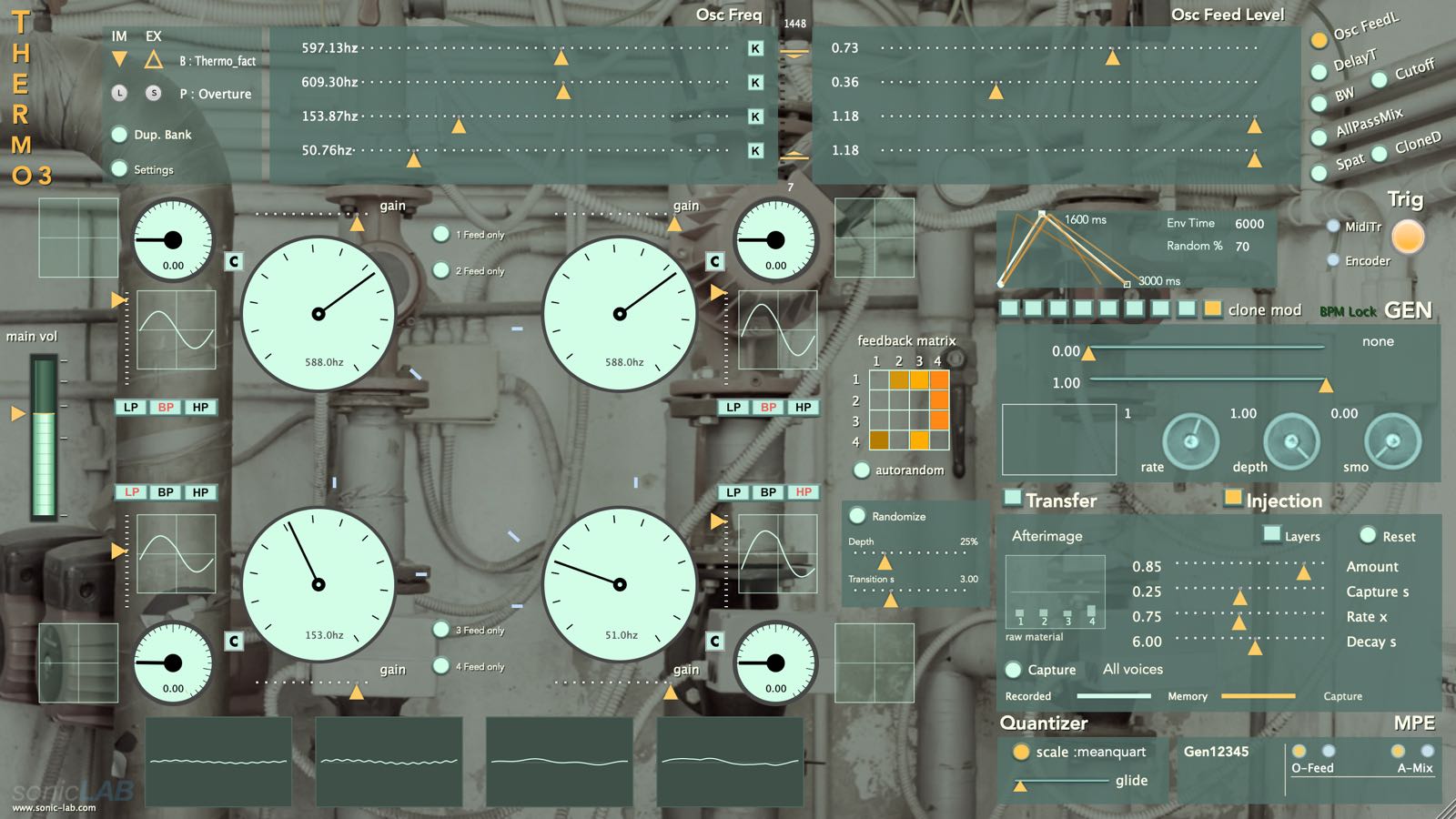
The answer begins with a feedback network that listens to itself. Four voices exchange sound; the instrument senses their activity, remembers interventions and changes the paths that sound takes next.
A conceptual map: each voice has a path to the listener and a separate path back into the network.
A modular patch can travel through similar sonic territory without copying the way Thermo3 makes its decisions. These are three different ambitions.
Evolving drones, beating, unstable textures and hands-on intervention. A well-designed rack can reach this territory with fewer exact correspondences.
Four sound-making and receiving voices, adjustable links between them, separate audible and return paths, sensing and independent movement.
The same adaptive routing, captured gestures, relative activity memory, per-voice heat state, clones and coordinated recall. This requires a custom design and testing.
Thermo3’s defining feature is the relationship between circulation, sensing, memory and intervention.
Imagine one oscillator receiving sound from the other three. It adds its own source, processes the combination, and then takes two different routes.
The filtered voice goes to the stereo panner or its individual output. Four individual oscillator outputs can be used without changing the feedback design.
A separate branch is delayed, regulated, transformed and heated. The instrument measures its activity and sends it back through the routing matrix.
The module names here are examples of useful roles, not a verified patch or an endorsement of a particular buying list. The real design problem is keeping enough independent paths available at once.
One per voice. Generate 3 illustrates frequency, phase, amplitude and harmonic control; it is not a copy of Thermo3’s source morphing.
Each voice needs its own filtering after local and network audio combine. Filter 8 illustrates multimode control, with a different topology from the software.
A 4ms VCA Matrix offers sixteen controllable routes. Cross-voice connections can be selected while diagonal routes stay muted.
Delay, level regulation, nonlinear Transfer and Thermal-like behaviour belong in the return paths, with simultaneous channels.
Followers, VCAs, comparators, scaling and smoothing let the instrument respond to how the four voices behave.
Several independent rates, random distributions and destinations need clocks, random voltages, function generators and utilities.
Four-voice mixing or individual outs, panning where wanted, line output and deliberate gain protection.
Preset-like recall needs a strategy for voltages, routing, hidden state and physical patch cables.
122 HP is only the starting footprint. Four 12 HP Generate 3 modules, four 12 HP Filter 8 modules and one 26 HP VCA Matrix add up to 122 HP. Return processing, sensing, modulation, mixing, case space and power still have to be allocated.
Modular hardware can produce related sounds. These operations ask the hardware to keep track of time, activity and the consequences of a performer’s action.
Strike introduces an excitation; Quench drains circulation while local sources remain. Reroute shifts connections according to activity. Threshold Dust makes sparse activity-dependent events.
Imprint stores the relative activity of the four voices. Afterimage captures raw audio material and returns it to the network; it replaces the earlier standalone Habituation Response. Habituate and Dwell remain modifiers that shape how a Response develops.
To approximate these operations in hardware, a gate or button is only the beginning. The rack also needs measurement, memory, return paths and several control channels working together.
Clip, atan, rectify and fold have recognizable modular relatives. Hysteresis, Excitable and Bistable rely on state and response rules; a distortion module alone cannot establish the same behaviour.
Spectral Drift shifts frequency by small offsets that accumulate on each return. Pitch transposition is a different process. Flow, Opposition and Adaptive need their own direction behaviour per voice.
Thermal follows Transfer. It senses activity, accumulates and loses heat over time, and changes colour, filtering, limited pitch movement and optional noise. The four voices each carry their own heat state.
Clones double more than the oscillator count. Reproducing four clone voices means additional source and processing paths, controlled entry into the network and enough modulation and sensing capacity to keep all eight paths musically useful.
These figures describe one plausible four-voice architecture. They were gathered for the original assessment on 17 October 2026 and are not live quotations or a tested bill of materials.
The detailed calculation for the four-voice version was £6,829–£9,529: £3,729 in specifically priced modules plus £3,100–£5,800 of planning allowances. Clone paths add a provisional £3,000–£5,000. The two disting NT units in the priced line are a capacity placeholder; concurrent DSP performance has not been verified.
| Item or allocation | Basis | Budget |
|---|---|---|
| 4 × Generate 3 | 4 × £299 | £1,196 |
| 4 × Filter 8 | 4 × £255 | £1,020 |
| 4ms VCA Matrix | 1 × £315 | £315 |
| Provisional DSP: 2 × disting NT | 2 × £599 | £1,198 |
| VCAs, followers, envelopes and utilities | Planning allowance | £1,000–£1,800 |
| Random modulation and function generators | Planning allowance | £700–£1,400 |
| Stereo mixing, panning and output | Planning allowance | £600–£1,200 |
| Powered cases, cables and accessories | Planning allowance | £800–£1,400 |
| Total | Four primary voices | £6,829–£9,529 |
Custom firmware and engineering, assembly, patching, commissioning, comparison tests, delivery, computer, DAW, interface and monitoring are outside this estimate. A different module selection, used hardware or a custom DSP design would change it.
A module list alone cannot prove that the behaviours can run together. Build and listen in stages, adding complexity only after each layer works.
The module roles and October 2026 UK prices come from the original Thermo3 and Eurorack: Architecture and Cost Assessment. Thermo3’s signal-flow and current Injection terminology were checked against its project and consolidated manual. Manufacturer pages describe capabilities; retailer listings underpinned the dated prices. No complete rack has been assembled or benchmarked for this comparison, and no sound-quality ranking follows from it.