THERMO3
A unique synthesizer with a thermodynamic engine. (and now in full 64bit double precision)
Available as VST3, AU, standalone.
Designed & developed by Sinan Bokesoy.
first release 05/2021

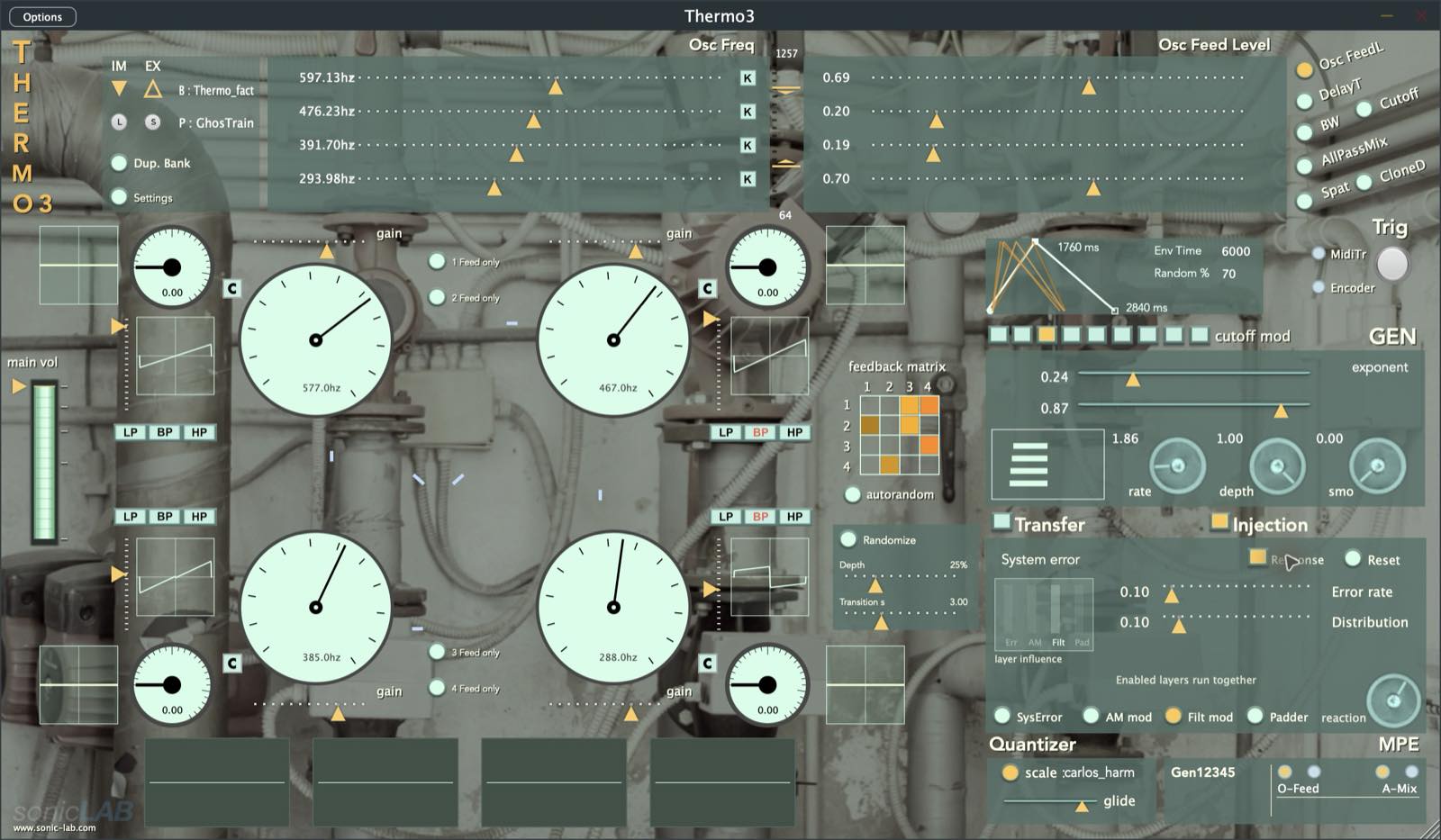
New ways to push, shape and heat the feedback network.
Thermo3 adds a set of Injection Responses, five new Transfer functions and an independent Thermal stage to the self-regulating engine of Thermo2.
Injection Responses
- Strike / Quench — push energy into the network or damp it.
- Afterimage — capture a short piece of sound and feed it back.
- Entrain — pull the oscillators’ movement toward or away from one another.
- Reroute — change how the oscillators feed each other.
- Imprint — capture the current balance between voices and let it influence what follows.
- Threshold Dust — introduce scattered, short-lived grains.
Transfer Functions
- Fold — bends strong signals back on themselves, creating changing harmonics.
- Hysteresis — responds differently as the signal rises and falls, giving the feedback a memory of its recent movement.
- Excitable — produces a burst when activity crosses a threshold, then needs time to recover.
- Bistable — shifts between two contrasting responses as activity develops.
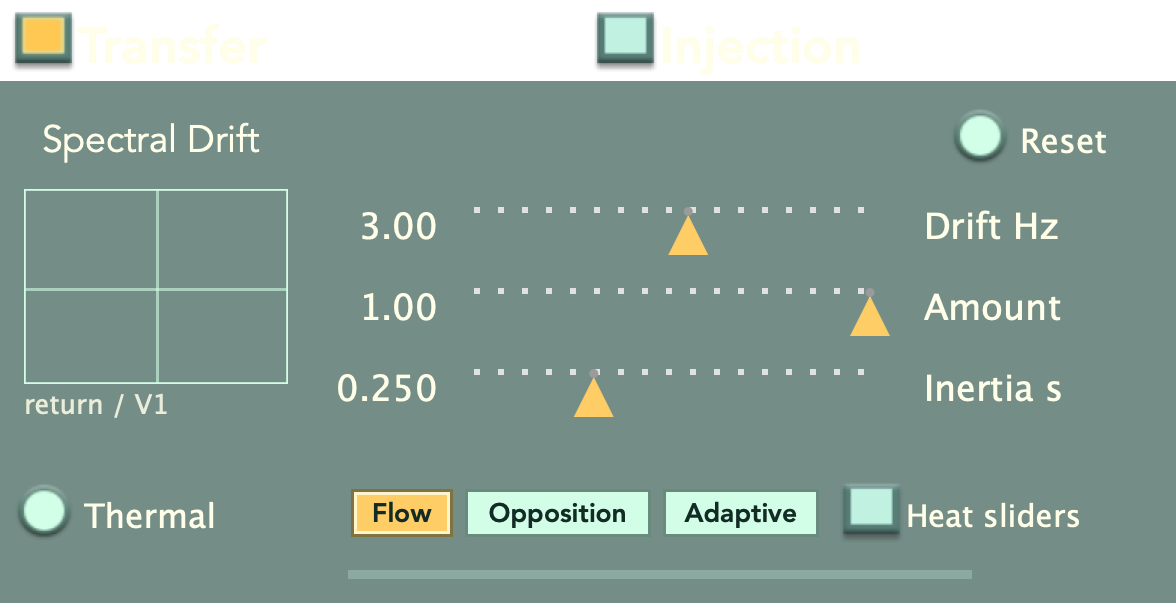
- Spectral Drift — slightly shifts the frequencies circulating through the feedback network, so the voices’ relationships evolve over time. Flow, Opposition and Adaptive choose how that drift acts across the voices.
Thermal
- An independent heat stage follows Transfer in the feedback loop.
- With heat, cooling, noise and strength controls.


And More
- Per-oscillator Feed only — a voice can process incoming sound without generating its own waveform.
- Randomize — adjustable depth and transition time, with Settings switches for which sections can change.
- Output and quality options — four separate mono voice outputs in the same plug-in, plus 4×, 8× and 16× oversampling.
- Workflow — a resizable editor, clearer activity displays, a larger preset browser, and named overwrite confirmation.
Thermo3 in Eurorack?
What would it take to build Thermo3 as a modular instrument? An illustrated look at its four-voice feedback architecture, the hardware it would need, and a dated cost estimate.
What is
Thermo?
Thermo is a self regulating hyper oscillator engine inspired by thermodynamic systems. The 4 oscillators of the Thermo are in continuous interaction sending each other their signals.
Each oscillator engine checks its environment conditions and takes decisions, 'self regulates', in reaction to these changes applied by the stochastic modulators or by the user through some perturbations called the injections into the system.
This defines already the basic structure of a thermodynamic engine which regulates its internal states by itself to maintain its quasi state.
All of this projected to a sound synthesis engine means the algorithmic performance of the continuous sonic transformations.
The enjeux between regulations and perturbations is exactly the uniqueness of Thermo taking you to unheard sonic territories.
Welcome to the politics of sound!
The entrophy of the Thermo engine is something perceive at all times. Thermo is the perfect synthesizer at the waveform level (not arranging discrete events) which finally does not express only static / interference waveforms but also a mass movement of a complex sonic structure within certain controllable margins.
The structure design is minimal, transparent, hence the purpose is not to create a complexity in a black box remaining inaccessible to the user.


4 Discrete
Oscillator Engines
4 discrete Oscillator engines in interaction with a 4X4 feedback matrix.
Thermo extends the classic oscillator concept and reaches a far more richer engine dedicated to waveform synthesis.
The oscillators of Thermo begin their signal path with a waveform generator (pure mathematical, not samples nor optimized tables) rendering basic waveforms and capable of morphing in between.
But then the signal path is something unusual.
Thermo Dynamic Interaction
The oscillator engine observes its environment by audio analysis and takes the actions to self regulate itself accordingly.
Besides the basic waveform generator and a standard filter section, the Thermo oscillator engine exhibits several components for systemic action, reaction and their dedicated DSP targets such as gain suppression, amplitude modulation, filter modulation.
The user can specify the degree of this reactive behavior, furthermore can inject some perturbations to the system against its self regulating acts. There are 3 different Injection models.
These perturbations generate some basic DSP such as AM, Filter Mod, Artificial system malfunctions, which effect the temporal and spectral aspects of the signal.
The oscillator engine is also subjected to the signals of other oscillators, a result of the feedback routing matrix, likewise its internal actions are effected not just by its own signal generation.
This interaction creates an organic behavior perceived as sonic transformation.
Stochastic
Modulation
Generators
Stochastic modulation generators (GENs) will modify the system conditions.
Each oscillator has 7 independent GENs which can modulate their dedicated synthesis parameters with a rich palette of stochastic distribution functions and standard waveforms.
The GENs are characteristic to sonicLAB and here you can directly perform their parameters with MPE controllers.
The video demonstrates how Thermo's quasi states are directly effected by the stochastic GEN modulation, which is some unpredictable change on a parameter. The outcome is the sonic transformation paid as a price for the reactions taken.

Whether you are a warehouse electronic musician or sound designer or a soundtrack composer ...

Features
Whether you are a warehouse electronic musician or sound designer or a soundtrack composer...
Unique thermodynamic synthesis engine.
4 oscillator engine with high precision sonic calculation, no quality degrading optimizations.
7 GEN's for each oscillator engine, 4 independent AR envelopes for the oscillators with random times.
3 Injection models, which can be applied also simultaneously. Several audio transfer functions for harmonic distortion, which can be modulated.
Pitch quantizer reading Scala tuning tables.
Full MPE support for performing real time modulations on sliders and GEN's.
Process visualization with inside out and efficient GUI design.
Thermo3 is available for OS X, Windows platforms as VST3, AU, standalone formats. Also Thermo v1.2 is available on iOS.
All sonicLAB products are 64bit only.
Recommended system : OSX Monterey or higher , Windows10 or higher.
Apple Silicon M1 1st gen. equivalent or better.